Chargement…
5
Knowledge
Ghostface
Shared identity of the antagonists in the Scream media franchise
Being
95ATK
50DEF
114HP
14SPD
56AURA
Full artQ2444720
CardsKnowledge
Ghostface
Shared identity of the antagonists in the Scream media franchise
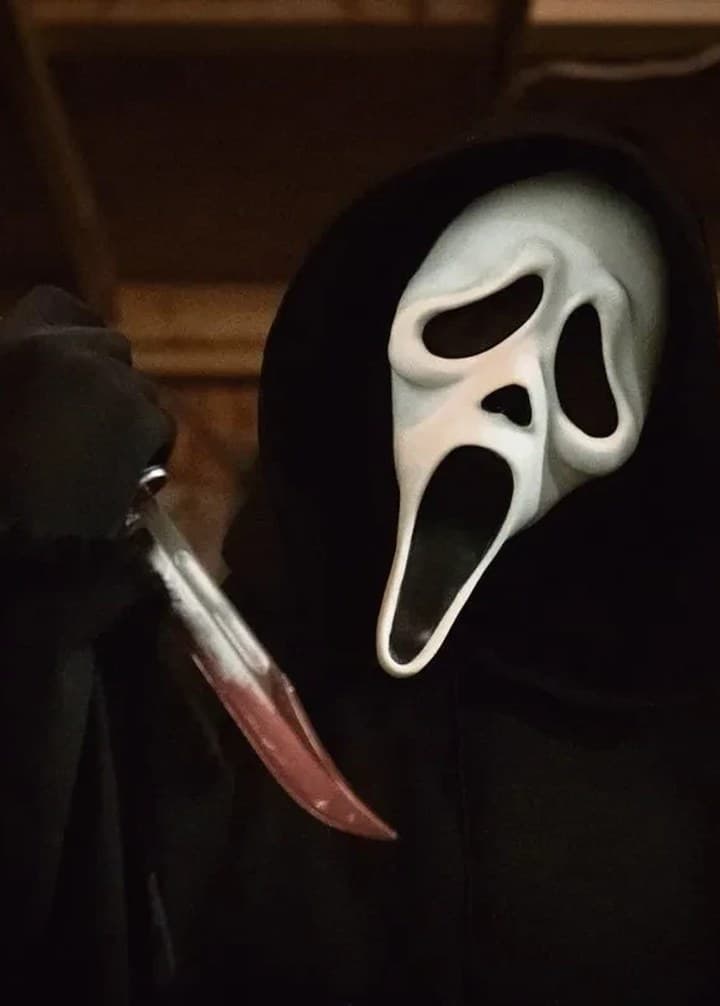
Ghostface (alternatively stylized as Ghost Face or GhostFace) is an identity that is adopted by the main antagonists of the Scream franchise. The figure was originally created by Kevin Williamson, and is primarily mute in person but voiced over the phone by Roger L. Jackson, regardless of who is behind the mask (as all killers use a voice changer utilizing that exact voice, starting in person with Scream). The disguise has been adopted by various characters in the movies and in the third season of the television series. Ghostface debuted in Scream (1996) as a disguise used by teenagers Billy Loomis (Skeet Ulrich) and Stu Macher (Matthew Lillard), during their killing spree in the fictional town of Woodsboro, particularly targeting Sidney Prescott (Neve Campbell). The mask was a popular Halloween costume created and designed by Fun World costume company before being chosen by Marianne Maddalena and Craven for the film. The identity is used primarily as a disguise for the antagonists of each film to conceal their identities while conducting serial murders, and as such has been portrayed by several actors. In the Scream universe, the costume is not unique and is easily obtainable, allowing others to wear a similar outfit. In the first movie, the costume is shown in packaging labeled "Father Death." Ghostface often calls their targets to taunt or threaten them, using a voice changer to hide their true identity. Later installments utilize modern technology of the time to taunt and pursue victims. Because the identity beneath the mask constantly shifts, Ghostface lacks a single, definitive motivation; their triggers range from revenge and fame-seeking to peer pressure. However, every iteration is a sadist whose thrill of the kill is fueled by a twisted obsession with horror movies and the ongoing continuity of the film series. The events of the first film provide worldwide fame and notoriety to the survivors, and the new Ghostface killers have motives that may sometimes be connected to the in-universe Stab film series, loose adaptations of the tell-all books about previous Ghostface killings by Gale Weathers (Courteney Cox). Sidney is often the main target for almost all the films, while Samantha "Sam" Carpenter (Melissa Barrera) and her half-sister, Tara (Jenna Ortega) are primarily targeted in the fifth and sixth films. The Ghostface persona remains the same throughout the Scream film series, featuring a black hood and cloak with a jagged base and a white rubber mask resembling a ghost with an anguished expression. Though each iteration of Ghostface is human, they often exhibit extreme durability against physical harm, high levels of physical strength, and an almost supernatural stealth ability, able to appear and disappear in seemingly impossible situations. In the 2015–2016 television series Scream, Ghostface was replaced by The Lakewood Slasher (created by the series' writers Jill Blotevogel, Dan Dworkin and Jay Beattie), who appeared in the series for the first two seasons, and by The Shallow Grove Slasher (created by Brian Sieve and Eoghan O'Donnell), who appeared in only the Halloween Special episodes of the second season; both are voiced by Mike Vaughn (who credited in the series' end credits as "The Voice"), due to licensing issues. The original Ghostface persona returned in Scream: Resurrection, once again voiced by Roger L. Jackson, replacing Vaughn. In the films, Ghostface has appeared in all entries to date, returning most recently in Scream 7, with Jackson reprising his role, also credited as "The Voice" in the film series' ending credits. The character has become a popular culture icon since its inception, referenced in film and television as well as spawning a series of action figures and merchandise, as well as parodies and titular spoofs, most notably in the Scary Movie franchise, where Ghostface is voiced by Dave Sheridan.
Read the article on Wikipedia ↗How these stats are calculated
Every value is derived from a measurement of the article, with no manual input. The measurements below were taken on October 25, 2026.
Being — Holds a square and attacks.
ATK
Attack
Article length
95 / 120
DEF
Defence
Reference density and count
50 / 120
HP
Hit points
Age and revision count
343 / 400
SPD
Speed
Recent edit activity and view trend
14 / 30
AURA
Aura
Language editions and incoming links
56 / 100
Health is read at a 3rd in battle: this Being enters play with 114. That is the number printed on the card — with Attack capped at 120, full-scale Health took five hits to fell a being.
Article size
71 kB
Sources cited
96
Sections
9
Revisions
2,407
Revisions in 90 days
14
Incoming links
273
Language editions
30
Views over 12 months
365,046
Created on
March 5, 2006
Wikidata statements
52
Full art — 95.1th percentile of notability
Rarity ranks cards by how famous their subject is: readership, number of languages and incoming links. This tier appears in 0.00% of cards pulled from packs. It says nothing about the card’s power, which is 632 out of 1000 here.
Print run
No copies minted yet. The print run closes on November 2, 2026; after that, this number will never change. Each copy carries its number, in the order it was obtained.
Loading prices…
Knowledge — type matchups
Strong against
CosmosLand
Weak against
MythPower
The source article
This card maps to the Wikidata item Q2444720, present in 30 Wikipedia editions.
Article text licensed under CC BY-SA 4.0.
Other Knowledge cards

9
Knowledge
Real Madrid Club de Fútbol
Association football club in Madrid, Spain
Concept
Magisterium
PrismQ8682

9
Knowledge
Vietnam War
Armed conflict in Vietnam, Laos, and Cambodia between North Vietnam and South Vietnam, from 1955 to 1975
Concept
Sovereignty
PrismQ8740

9
Knowledge
Map
Publication type or genre, visual representation of geographic space
Concept
Magisterium
RareQ4006

9
Knowledge
Dam
Barrier that impounds water or underground streams
Land
Abbey
EpicQ12323